
You may think my goal is to get better, it’s not, I’m concentrating my energy on not getting worse. Most illnesses start out strong and then fade over time. When you get a cold, you have those couple days of being miserable and then a few more days of sniffles or a lingering cough. Chronic illnesses aren’t like that, they ebb and flow over time. My pollen allergies do so predictably, every spring I get worse and then in the summer I get better. Myalgic Encephalomyelitis (ME or also ME/CFS) is different still, it’s really easy to get worse (by pushing your body to do more than it has energy for) and incredibly hard to get better (extensive rest and magic – aka science we don’t yet understand). My Long Covid has become ME (by meeting a few criteria, particularly passing the 6 month benchmark) and it’s the reason that it’s so important to rest much more than you think you might need to after any covid infection. I’m not convinced you can avoid long covid, but this post will demonstrate what has happened each time I’ve pushed my body too hard. I only have mild/moderate ME. People with severe ME are not only bedridden, they also can’t handle any stimuli (light/sound). The physics girl has been public with her experience with severe post covid ME. So, my goal first and foremost is to not get more severe (which is not to say it was anyone’s fault who has severe ME that they got to that point, only to say that since I’ve been lucky enough to not have it yet, I’m trying to stay that way). Then, as my body lets me know that I have the capacity, I will start working my way toward feeling better.
I wrote about both times I crashed (times I overdid it enough that I got significantly worse for a few days) shortly after they happened. Then I’ll share a summary of how each crash impacted my baseline and what’s happened since.
October 20 – 23, 2022
This weekend is my first long covid crash. I’m in the sweet spot where my kid is old enough and my parents are young enough that I don’t need to be caretaker for anyone but myself. That’s the only reason I’ve been able to rest sufficiently to avoid crashing before now. I had enough rest stockpiled that it took a brutal combo to knock me out:
- Puppy was sick and woke me up at night. (x3 nights)
- Went to the vet during my usual morning nap time on Friday and had a doctor’s appointment in the afternoon so that nap time was out too.
- Took non-drowsy Sudafed before bed Friday night, did not realize that my body would take non-drowsy to mean “you will not sleep” (I’m particularly sensitive to stimulants like caffeine), and in my fatigued state took another Sudafed in the morning so I didn’t nap Saturday either.
- I was menstruating.
- There was bad weather and pressure changes impact my symptoms.
The weekend-long crash involved vomiting (previously I’ve had nausea but this was the first time it progressed), feeling dizzy when standing (new symptom), and feeling weak (worsened symptom).
I can’t blame the puppy, and the poor guy suffered some consequences because I wasn’t able to take him for as many walks. I had to ask for help getting him out as often as he needed because I felt unsteady going down the stairs to the yard. We found new ways to play where I got to rest and he still had fun.
That weekend was the onset of my POTS (Postural Orthostatic Tachycardia Syndrome). The long covid clinic had previously told me to hydrate and increase my salt intake, which I’d been doing by drinking a ton of water and eating some extra Pringles. Until that point that was sufficient. After that weekend a stack of Pringles was not enough salt (100 mg sodium per 10 chips) – I got clarification from the long covid clinic and learned I needed at least 3,000 mg sodium per day. Switching to electrolyte drink mixes got me there and I was able to stabilize the new symptoms so I occasionally felt light headed, rather than constantly being dizzy and unstable whenever I was upright. Present day Tina is still light headed when standing, and now that it’s summer it can take more than 8,000 mg of sodium for me to retain sufficient liquid to get blood to my head. (Some future post will share more about my journey with POTS, and it has indeed been a journey.)
January 26 – February 6, 2023
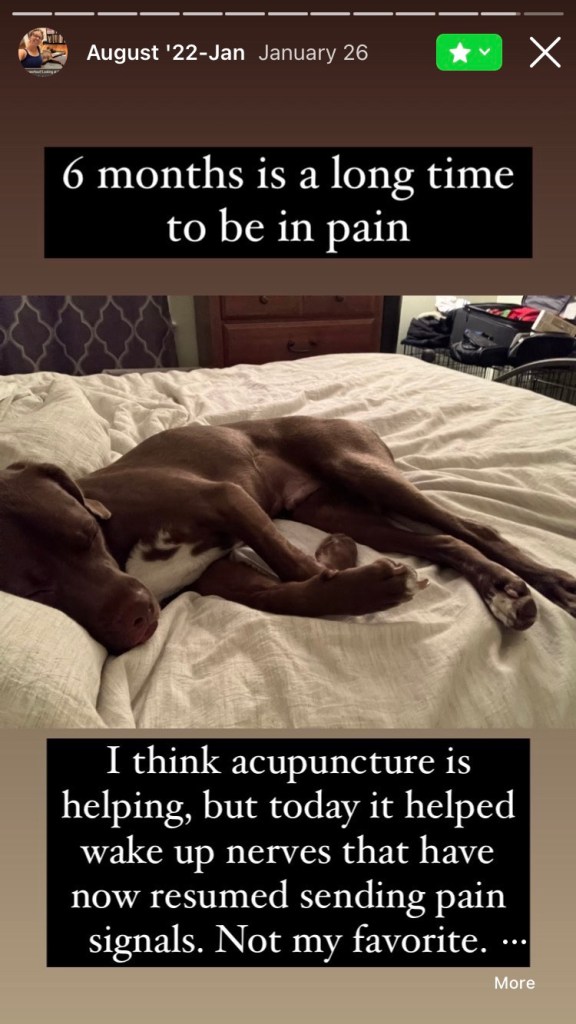
Thursday January 26, 2023 I had my third acupuncture appointment. The first appointment I was hopeful this would really help me, someone who was thinking whole body rather than one specialty at a time, and after the appointment I got home and took a deeply restful nap. One characteristic of ME is that sleep isn’t restful. I often wake up in the morning feeling more fatigued than when I went to bed the night before. However, that first acupuncture appointment also brought a lot of the pain that I’d tuned out back to the forefront. I went back and told the acupuncturist that he had to fix it since he broke it. He hasn’t figured out how to do that yet.

Friday I drove to Vermont to visit with college friends and drove home Jan 29. I planned out my trip with my occupational therapist so both drives were done midday when I’m most alert, I stopped half way to take a break (at a McDonald’s so I could get fries and a soda to hydrate and cap up my sodium) and stretch. My friend I was visiting was great about checking in with me, I told them ahead of time what I needed, and I successfully went to bed early and took rest breaks during the day.
Despite my best efforts, I still crashed when I got home. 3 days of extreme exhaustion (sleeping 14 hours a day, when I usually need 10). Followed by a few days of pain preventing restful sleep. February 7th was the first day I had the energy to do things again.
I haven’t tried to drive that far since then. Which means that my parents have driven to visit me, and once to pick me up to visit them, because I’m scared to test that limit even though I quit acupuncture shortly after that. (It turned out my acupuncturist was using too many needles and further overwhelming my already overwhelmed system. I do plan to try acupuncture again, at a new location, in the fall.)
The next drop in baseline wasn’t a crash but was due to a medication change. The whole story is complicated but suffice it to say I learned in April that propranolol is essential to my current level of functioning. While I was off the medication I was hyper aware of every heart rate spike – I really did not want to get worse. So I didn’t push myself at all, which was the correct choice, and still resulted in a decrease in functioning. I had been going to physical therapy and very very slowly increasing my strength and cardio (I followed the Levine protocol but went even slower than that very gradual plan). Once I got back on the medication I had to start back at zero. It’s August and I’m still not doing cardio on my rowing machine yet, so far I’m using it as another gentle strength exercise. It will take months to get back to where I was (which wasn’t particularly impressive, and because of my POTS included only seated or reclined exercises).
The most recent drop in baseline was also a medication change. This one came as a surprise! Some antidepressants are used at low doses for headaches. I tried taking Cymbalta but it didn’t make any difference so after giving it a solid try (4 months) I went off it. Even with the low dose I’d been on my doctor was extra careful and had me decrease the dose before quitting entirely. I noticed that my POTS symptoms were worse, in particular I’d never had the experience where raising my arms over my head caused light headedness, even though many people with POTS have that experience. I’m now among them! I’ve been completely off Cymbalta for 2.5 weeks but that new symptom seems to be here to stay. It took me a while to connect the medication with the symptom, because it’s a medicine I took for my headache, that I know is used for depression, neither of which have anything to do with getting dizzy when I pick my arms up! Because I use an app to track medications, and I remembered the date that the symptoms started (the night before my one year covid-versary) I was able to throw that connection out in my family group chat. And because my family group chat is composed entirely of people who had/have careers in medicine, I heard back that going off SNRIs (which Cymbalta is) can cause Orthostatic Tachycardia (the OT of POTS). My sister-in-law is a neurologist and so she’s used Cymbalta for headaches before, she’s never had a patient experience the orthostatic tachycardia and says it’s really only listed as a withdrawal side effect for people on much higher doses than I was.
That’s how sensitive my body is right now. If there’s a possibility, I will experience it because I’m that unstable. So for the foreseeable future my primary goal will continue to be: don’t get worse!
 Tina Cardone